reservoirpy.observables.memory_capacity#
- reservoirpy.observables.memory_capacity(
- model: Model,
- k_max: int,
- as_list: bool = False,
- series: ndarray | None = None,
- test_size: int | float = 0.2,
- seed: int | RandomState | Generator | None = None,
Memory Capacity of a model
The Memory Capacity [1] (MC) measure is defined as:
\[MC = \sum_{k=1}^{k_{max}} MC_k\]where:
\[MC_k = \rho^2(u(t-k), y_k(t)) = {cov^2[u(t-k), y_k(t)] \over var(u(t-k)) \cdot var(y_k(t))}\]This measure is commonly used in reservoir computing to evaluate the ability of a network to recall the previous timesteps. By default, the timeseries \(u\) is an i.i.d. uniform signal in [-0.8, 0.8].
- Parameters:
model (
reservoirpy.Model) – A ReservoirPy model on which the memory capacity is tested. Must have only one input and output node.k_max (int) – Maximum time lag between input and output. A common rule of thumb is to choose k_max = 2*reservoir.units.
as_list (bool, optional, defaults to False) – If True, returns an array in which out[k] \(= MC_{k+1}\)
series (array of shape (timesteps, 1), optional) – If specified, is used as the timeseries \(u\).
test_size (int or float) – Number of timesteps for the training phase. Can also be specified as a float ratio.
seed (int or
numpy.random.Generator, optional) – Random state seed for reproducibility.
- Returns:
float, between 0 and k_max.
If as_list is set to True, returns an array of shape (k_max, ).
Examples
>>> from reservoirpy.nodes import Reservoir, Ridge
>>> from reservoirpy.observables import memory_capacity
>>> model = Reservoir(100, sr=1, seed=1) >> Ridge(ridge=1e-4)
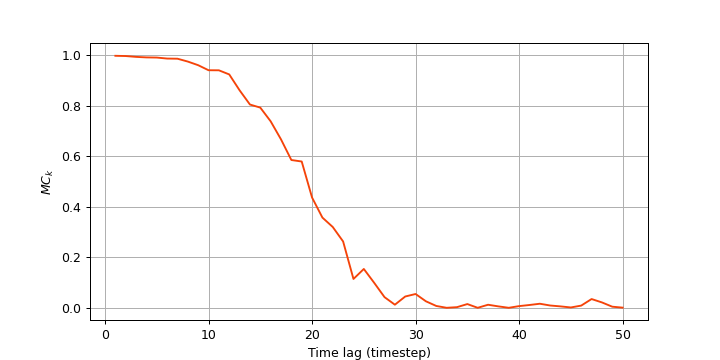
>>> mcs = memory_capacity(model, k_max=50, as_list=True, seed=1)
>>> print(f"Memory capacity of the model: {np.sum(mcs):.4}")
Memory capacity of the model: 18.78
References