reservoirpy.datasets.lorenz#
- reservoirpy.datasets.lorenz(
- n_timesteps: int,
- rho: float = 28.0,
- sigma: float = 10.0,
- beta: float = 2.6666666666666665,
- x0: list | ndarray = [1.0, 1.0, 1.0],
- h: float = 0.03,
- **kwargs,
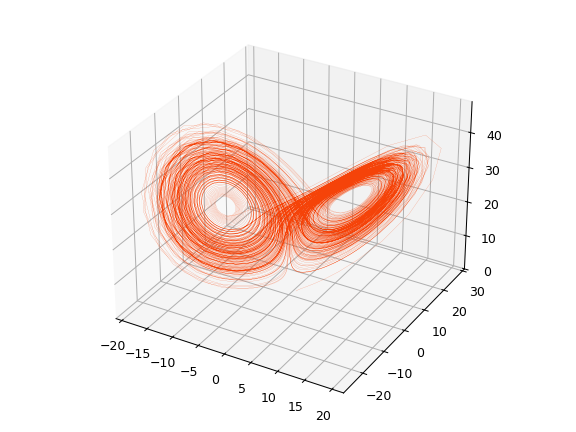
Lorenz attractor timeseries as defined by Lorenz in 1963 [6] [7].
\[\begin{split}\frac{\mathrm{d}x}{\mathrm{d}t} &= \sigma (y-x) \\ \frac{\mathrm{d}y}{\mathrm{d}t} &= x(\rho - z) - y \\ \frac{\mathrm{d}z}{\mathrm{d}t} &= xy - \beta z\end{split}\]- Parameters:
n_timesteps (int) – Number of timesteps to generate.
rho (float, default to 28.0) – \(\rho\) parameter of the system.
sigma (float, default to 10.0) – \(\sigma\) parameter of the system.
beta (float, default to 8/3) – \(\beta\) parameter of the system.
x0 (array-like of shape (3,), default to [1.0, 1.0, 1.0]) – Initial conditions of the system.
h (float, default to 0.03) – Time delta between two discrete timesteps.
**kwargs – Other parameters to pass to the scipy.integrate.solve_ivp solver.
- Return type:
Examples
>>> from reservoirpy.datasets import lorenz
>>> timeseries = lorenz(10000)
>>> timeseries.shape
(10000, 3)
- Returns:
Lorenz attractor timeseries.
- Return type:
array of shape (n_timesteps, 3)
- Parameters:
References